GCA Framework Explained: What Schools and Trusts Need to Know


If you book supply teachers or education support staff through a public framework, 2026 has brought two changes worth knowing about.
The first is a change of name. Crown Commercial Service (CCS) became the Government Commercial Agency (GCA) on 1 April 2026. The second is a change of agreement. The previous supply staffing framework has been replaced by RM6376 Supply Teachers and Education Recruitment, which went live at the end of April 2026 and runs through to 29 April 2029.
The new name is the visible change. The more significant one arrives next month, September 2026, when the rules on how academy trusts procure supply staff tighten. Below is a guide to what has changed, what hasn’t, and what to do before the new academic year.
The short version
If you have two minutes rather than ten:
- New name, new agreement. CCS is now GCA. RM6376 replaces the previous supply staffing framework.
- Live dates. 30 April 2026 to 29 April 2029.
- Capped supplier fees. The framework sets a published ceiling on what an agency can charge on top of a worker’s pay and employment costs.
- The September 2026 position for trusts. Under the 2026 Academy Trusts Handbook, single and multi-academy trusts are expected to procure agency supply staff through RM6376 unless they can evidence an alternative compliant arrangement at rates no higher than the framework’s.
- Optional but useful for maintained schools. Local authority maintained schools are not mandated to use the framework, though many choose to for the transparency and the standard terms.
- Procurement Act 2023 still applies. Any school or trust spending above PA23 thresholds needs a compliant route to market. RM6376 provides one.
For anyone who has used the previous framework, the mechanics will feel familiar: find a supplier, sign a short order form, book your staff.
What’s actually new?
1. The September 2026 expectation for academy trusts
This is the change most likely to need action. From September 2026, the Academy Trusts Handbook sets the expectation that single and multi-academy trusts source agency supply staff through GCA. Trusts that prefer to stay outside the framework can do so, but they need to demonstrate that their alternative arrangement is compliant under the Procurement Act 2023 and that the rates are no higher than those available through GCA. Spend is assessed at trust level, aggregated across all schools, rather than school by school.
In practice, trusts booking outside a framework will want to review those arrangements ahead of the new academic year. It’s also a governance point: trustees and CFOs will need to be able to evidence the position in routine reporting.
Local authority maintained schools sit outside the mandate. Many still use the framework because capped fees, standard call-off terms and pre-vetted suppliers are useful regardless of whether they’re required. Independent schools cannot access GCA.
2. Capped supplier fees
GCA publishes a maximum daily supplier fee – the amount an agency can charge above the worker’s pay and associated employment costs. The caps were negotiated by the Department for Education alongside GCA.
It’s worth being clear about what the cap does and doesn’t do. It limits agency margin. It does not affect what supply teachers and support staff are paid, and it isn’t intended to change the availability or quality of the people who walk into your classroom.
3. Two lots, two routes to market
GCA is split into two lots, and the right one depends on how you want to buy.
Lot 1 – Teachers and Education Recruitment. Direct appointment of teachers, support staff and other school-based roles on a booking-by-booking basis. Most single schools and smaller trusts will use this route, awarding without competition: choose a named supplier, sign the short order form, start booking.
Lot 2 – Managed Service Provision. Appointing one provider to manage temporary and permanent staffing across a trust, drawing on their wider supply chain. Larger trusts typically use Lot 2 where they want consolidated reporting, a single point of accountability and less administrative load across multiple schools. This route can be awarded with competition through a mini-competition where a more tailored arrangement is needed.
Where Prospero fits
Prospero Group is a named supplier on both lots of the GCA Framework – Lot 1 and Lot 2 – giving schools and trusts an alternative compliant route to market.
That matters for one practical reason: your procurement route can change without your staffing partner having to. If your trust starts on Lot 1 and later decides a managed service is the better fit, we’re already there. No re-tendering a supplier relationship, no rebuilding a talent pipeline from scratch.
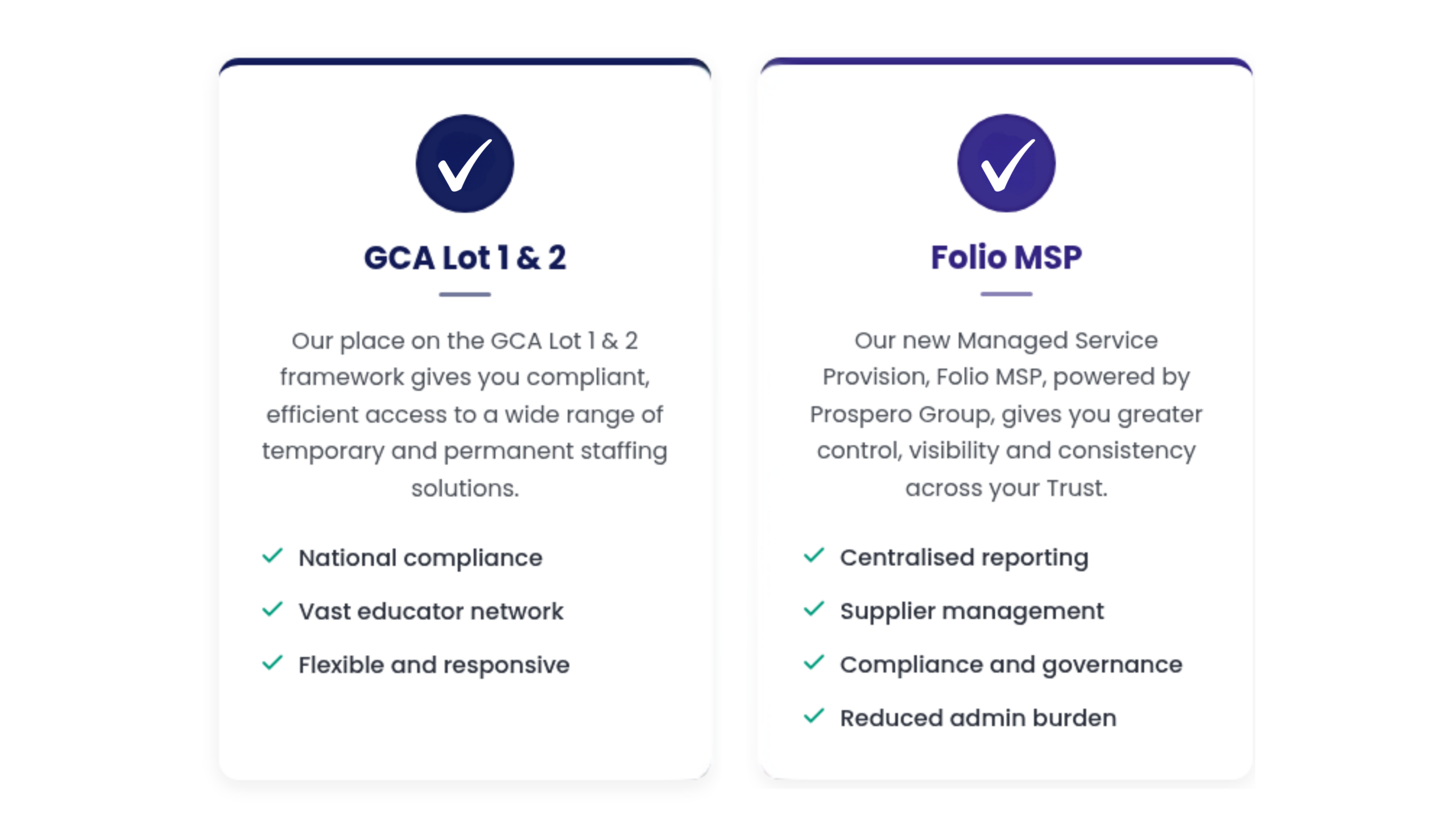
Alongside the frameworks, our own managed service provision, Folio MSP, gives trusts centralised reporting, supplier management, compliance oversight and a meaningful reduction in day-to-day admin – delivered under framework terms.
What hasn’t changed
Plenty of the operational detail carries over.
Temp-to-perm at 12 weeks. A worker engaged through the framework can move onto a permanent contract with no transfer fee once they’ve completed 12 weeks, subject to four weeks’ notice. There are also structured reductions in supplier margin beyond the 12-week point.
Nominated workers. You can still bring a known and trusted supply worker onto framework terms through a named supplier.
Safeguarding standards. Vetting continues to follow Keeping Children Safe in Education. Every supplier named on GCA is required to vet in line with KCSiE, and that obligation sits explicitly in the framework terms.
The underlying principle. Schools and trusts use the framework to access compliant suppliers on standard terms, with visible charges and consistent safeguards. GCA sharpens that model rather than replacing it.
Practical next steps
Multi-academy trusts. Map your current supply arrangements against the September position, school by school. Identify anything booked outside a framework and agree a transition plan. Decide whether direct appointment under Lot 1 or a managed service under Lot 2 better suits your operating model, and check that your incumbent suppliers appear on the published RM6376 supplier list.
Single-academy trusts and smaller schools. The same expectation applies, scaled to your size. For most, Lot 1 awarded without competition is the quickest and simplest route: pick your supplier, sign the short order form, carry on booking.
Local authority maintained schools. Using the framework remains your choice. It’s still worth understanding, because capped fees, transparent charging and standard terms are a sensible default even when they aren’t required and if your spend exceeds PA23 thresholds, GCA gives you a compliant answer.
Our position
Prospero has been supplying schools and trusts across the UK for over 25 years, with regional teams who know their local education landscape. We’re named on GCA RM6376 Lot 1 and Lot 2 and we deliver our own managed service through Folio MSP.
If you’re working out what the September mandate means for your trust, or which route makes most sense for your schools, our team is happy to walk you through it – no obligation, just a straightforward conversation about your options.
Teaching Blog
No results found.....